
French researchers highlight more complex and potentially more morbid types of revisional bariatric surgeries
Updated: Mar 31
Researchers in France have identified a significant shift in the country towards more complex and potentially more morbid types of revisional metabolic bariatric surgeries (RMBS), underscoring the need of careful patient selection through preoperative assessment and personalised postoperative management to reduce risks and optimise outcomes in this population.

The aim of their observational study was to assess the rate of RMBS in France and to outline the associated complications and risk factors, by comparing morbidity and mortality rates between primary and RMBS. Initially, the researchers compared primary MBS to overall RMBS and then compared primary surgery to different types of revisional surgery (revisional after AGB, revisional after SG and revisional after GB). They then stratified patients into two subgroups, those patients undergoing SG and those undergoing GB. Within each subgroup, they compared primary procedures with revisional procedures after GB and after SG.
A sensitivity analysis was also performed on a group of patients who had a revisional procedure at least two years after the primary surgery and with a main diagnosis of obesity. This, the researchers noted, suggested that the reoperation was performed for insufficient weight loss or weight recurrence.
Outcomes
Between January 2016 and December 31, 2022, a total of 322,254 bariatric procedures were performed on 302,418 patients. After applying the selection criteria, 284,271 procedures per-formed on 279,285 (92.4%) patients were included for analysis. The overall rate of revisional procedures was 12.8% (n=36,378). During the study period, 247,893 (87.2%) patients underwent their first bariatric intervention, 15,168 (5.3%%) had their second intervention, 17,789 (6.3%) had their third and 3421 (1.2%) had at least their fourth.
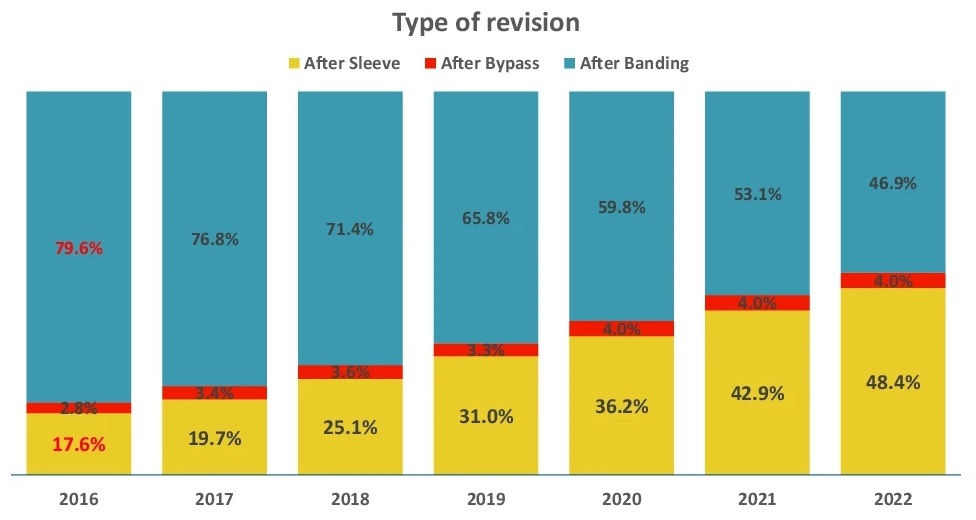
In 2016, the majority of revisional procedures involved revising a primary AGB (79.6%). However, by 2022, revisions of primary SG became the most performed in France, accounting for 48.4% of cases (Figure 1). Those undergoing RMBS were older (43.8 versus 40.0 years old, p<0.001), had a higher proportion of females (87.0% versus 78.7%, p<0.001) and exhibited a higher prevalence of comorbidities (23.5% versus20.1% with Charlson comorbidity index ≥ 1, p<0.001).
Overall, SG was the most common procedure, accounting for 67.8% (n=192,627) of cases, followed by GB at 28.5% (n=81,133) and AGB at 3.2% (n=9,064). SG was more frequently performed as a primary procedure compared to a revisional procedure, with primary SG accounting for 71.7% of cases compared to 40.8% for revisional SG. However, GB was more commonly performed as a revisional procedure, with revisional GB accounting for 53.3% compared to 24.9% for primary GB.
Revisional procedures resulted in significantly higher rates of severe complications compared to primary procedures according to the Clavien–Dindo classification (primary2.5%, revisional after AGB 3.4%, revisional after SG 6.9% and revisional after GB 9.0%, p<0.001). This trend was also observed for abdominal sepsis and bleeding.
The complication rate for primary bariatric procedures remained stable during the study period (2.4% in 2016, 2.2% in 2019 and 3.0% in2022, p=0.07), however the rate significantly increased for revisional surgery (3.5% in 2016, 4.0% in 2019 and 6.4% in 2022, p=0.009).
Overall revisional procedures were significantly associated with an increased risk of severe complications (1.58, 95% CI 1.49–1.68, p<0.001. Subsequent analyses evaluating different sequences of revisional surgery confirmed that revisional procedures were associated with an increased risk of severe complications, with revisional after GB having the highest OR (2.70, 95% CI 2.27–3.20, p<0.001).
In addition, patients who underwent revisional SG (SG after AGB, or SG after SG, i.e., re-sleeve) experienced significantly more severe complications than those who underwent primary SG. After adjustment, the odds ratio was 1.25 (95% CI 1.12 –1.39, p<0.001) for SG after AGB and 2.87 (95% CI 2.27–3.56, p<0.001) for SG after SG compared to primary SG.
Similarly, GB after AGB and GB after SG were associated with significantly more severe complications than primary GB. The odds ratio was 1.32 (95% CI 1.19–1.47, p<0.001) for GB after AGB and1.86 (95% CI 1.69–2.04, p<0.001) for GB after SG compared to primary GB.
For patients having a revisional surgery at least two years after the primary procedure with an indication of insufficient weight loss, the overall complication rate for revisional procedures was 4.9% (with an OR of 1.61, 95% CI 1.50–1.74, p<0.001).
The investigators stated that the outcomes from this study suggests that surgeons with greater experience and expertise in bariatric procedures tend to achieve better outcomes, including lower rates of complications and improved patient safety. Likewise, high-volume surgical centres, where a large number of bariatric procedures are performed regularly, were also associated with superior outcomes compared to lower-volume centres.
“Further research aimed at refining surgical techniques, evaluating long-term pharmacological interventions, and investigating the impact of surgeon experience is essential to improve the efficacy and safety of revisional bariatric procedures,” the researchers cautioned.
The findings were reported in the paper, ‘Investigating the trend of revisional bariatric surgery, the complications, and associated risk factors in France’, published in the International Journal of Obesity. To access this paper, please click here


Comments